Offices
Tenant floors and end-of-trip facilities, often under one building-wide contract.
Commercial and strata facilities management, Melbourne
Office Mon to Fri, 9:00 am to 5:00 pm info@goldenstar.au
Sanitary and nappy bins
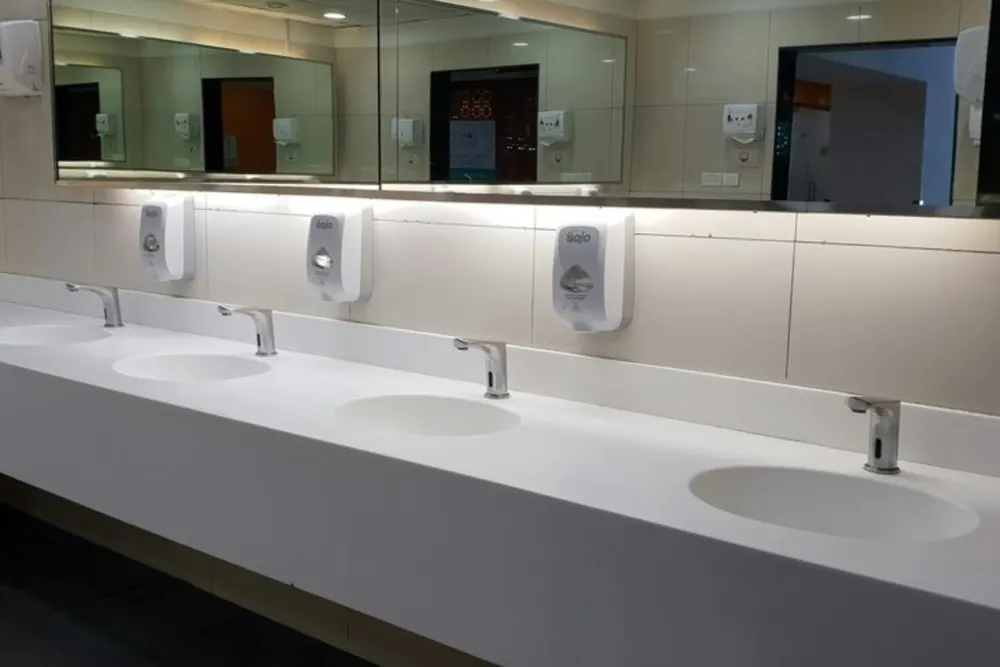
Sanitary bins in Melbourne workplaces are sealed, lined disposal units placed in female and accessible toilets, exchanged on a schedule and taken away for disposal so nobody on site handles the waste. Golden Star arranges sanitary bin services as part of its washroom hygiene services, with nappy bins for childcare, retail and public toilets.
The service
A sanitary bin service is more than the bin. It covers the unit, the exchange, the transport of the waste and a record of every visit.
Exchange cycles
The exchange cycle depends on how many people use each cubicle. A bin that overflows between visits is the most common complaint about sanitary services, so busy sites need shorter cycles.
Weekly
Fortnightly
Every four weeks
These are common patterns, not fixed rules. Your cycle is set from the number of users and changed if units fill early.
Who it is for
Any workplace with female staff or visitors needs a hygienic way to dispose of sanitary products. These are the sites we set up most.
Tenant floors and end-of-trip facilities, often under one building-wide contract.
Nappy bins in change areas, exchanged often. Our childcare cleaning page covers the rest of the routine.
Customer toilets and parents' rooms with heavy weekend use.
Student and staff toilets, serviced before or after classes.
Patient toilets beside clinical rooms, linked to our medical cleaning routines.
Shift workers sharing a small number of cubicles, so units fill quickly.
Change rooms in constant use, open early and late.
Public toilets near function rooms and bars, busiest on event nights.
How it runs
Setting up takes one site visit and one install day. After that, the service runs on its cycle and the site supervisor keeps an eye on it with the rest of your washrooms.
We count female and accessible cubicles and parents' rooms on every floor, and ask roughly how many people use each washroom.
Units are fitted in one visit, and old units from a previous provider are left for them to collect.
On each cycle, full units are bagged, sealed and swapped for clean ones, then the visit is logged.
If units are full before their date, or half empty at exchange, the cycle is changed and the price adjusted.

Sanitary bins sit under workplace safety law on site and waste rules once they leave. EPA Victoria regulates how waste is transported and disposed of in Victoria.
| Item | Detail |
|---|---|
| Workplace amenities | WorkSafe Victoria's amenities compliance code covers sanitary disposal in toilets used by women |
| Employer duty | Occupational Health and Safety Act 2004 (Vic): adequate welfare facilities for workers |
| Childcare | National Quality Standard Quality Area 2 covers children's health and safety, including hygiene practices |
| Insurance | Details sit on our safety and insurance page |
Price guide
Sanitary bins are charged per unit per month, and the exchange cycle sets most of the price. A four-weekly office unit costs less than a weekly unit in a shopping centre.
| Item | From | What changes the price |
|---|---|---|
| Sanitary bin, four-weekly | On quote | Unit type and number of units on site |
| Sanitary bin, fortnightly or weekly | On quote | How often the unit is exchanged |
| Nappy bin | On quote | Size and exchange cycle |
| Extra exchange | On quote | Units that fill before the due date |
Many sanitary contracts renew automatically unless notice is given within a set window before the end date. Ask any provider for that window in writing.
We arrange sanitary bins for workplaces across metropolitan Melbourne, from the CBD and Docklands to Frankston, Cranbourne and the outer north, and for some regional Victorian sites when there is capacity. Exchange rounds are grouped by area. Browse the Melbourne regions we cover.
A cubicle count by floor is the most useful thing to send with a quote request.
Pricing is per unit, per month, and moves with the unit type and exchange cycle. A short cycle in a busy site costs more per unit than a four-weekly office cycle.
Often enough that no unit is full before its next exchange. That is usually every four weeks in an office, fortnightly in schools and gyms, and weekly in public toilets and childcare change rooms.
Service staff follow your sign-in and access rules and are inducted before the first visit.
Yes. Exchanges are often booked before opening or in the evening so washrooms are not closed while staff or customers are using them.
Check your current contract's notice period first, because early exit can carry a fee. We can then book our install for the day after the old units are collected so there is no gap.
We cover every suburb of metropolitan Melbourne. Regional Victorian workplaces are taken on case by case.
Tell us how many female and accessible cubicles and parents' rooms the site has. We will confirm the count on site and send a monthly price per unit.